Sunday, 30 April 2017

The Suburban House

Rationale for Suburban Living

- Space, materiality, light, gardens, informality, openness.

- Low density living

- Villa/bungalow within large gardens (ie. building within landscape)
- Abundant amenity, more space & larger blocks, living further apart, openness.
- Seen as good place for children to grow up.

- Interaction with outdoors - patio, backyard, front yard, street, neighbours

Dual quality of suburbia
- Separation and distinction from the city
- Inextricable link to the city - transportation revolution (car, trams, trains)
- Suburb as liminal (in-between) space between country (openness) & city (employment, lifestyle)


- Emerged in postwar USA, Australia, New Zealand.
- Inner city associated with disease and poverty.

Evolution of Suburb
- Smaller plots, larger houses (ie. increased site coverage), typically 2 storeys, reduced outdoor space (internalised space).
- Less natural lighting & ventilation, increased use of artificial lighting, heating and A/C.


Changing Demographics

- Non-nuclear family entities


Flexibility


Material Choice

Masonry

- Brick - raw, painted, rendered
- Concrete - precast, in-situ, blockwork
- Tiles
- Terracotta
- Rammed Earth

Stone

- Slate (roofing)
- Granite
- Marble
- Basalt (dark volcanic stone)
- Sandstone
- Limestone
- Engineered Stone

Timber

- Oak
- Larch
- Pine
- Plywood
- MDF
- Veneer
- Cross-Laminated

Glass

- Clear
- Low-e
- Tinted
- Frosted, fritted
- Stained
- Coloured
- Toughened, Laminated

Metal

- Steel - mild, black, rusted (Corten), stainless
- Aluminium
- Zinc
- Bronze
- Copper
- Zinc


Tucson Mountain Retreat (Arizona USA, DUST)

Tucson Mountain Retreat (Arizona USA, DUST)

https://www.dezeen.com/2013/05/03/tucson-mountain-retreat-by-dust/
http://ihavenotv.com/mountain-the-worlds-most-extraordinary-homes

Opportunities
- Extraordinary panorama of desert ecosystem and landscape, fragile beauty (dry earth screed, shrub and cactuses)
- Fantasy of escaping into the wild desert, far away from civilisation & human contact.
- Embrace rather than exploit the landscape. Enhancing 

Challenges
- Very hot, dry climate (extreme)

Planning
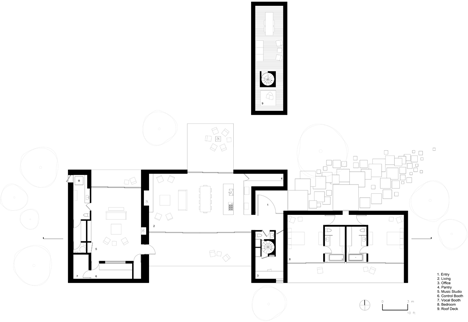
- 3 distinct zones: Music/entertainment, Living/dining, Sleeping
- Circulation: Each zone is accessed by leaving the interior and stepping outside, before entering a new zone. Provides acoustic separation, allows direct interaction with landscape (eg. down the stepping stones on shaded north-east entry)

Tucson Mountain Retreat by DUST

General Principles:
- Understated, practical, not ornate or flashy.
- Blending in and be in harmony

Response to Site:
- Use of rammed earth: A widely available material at the site, cheap and easily sourced, provides superior thermal mass, no environmental side effects, provides poetic response to site with beautiful colours and textures that connects well with the landscape, same colour as earth, provides a multi-sensory response (tactile, visual and auditory)

- Orientation: House orientated along East-West axis, minimised door/window openings on East & West to reduce solar heat gain.  Deep overhangs for South-facing facades that capture winter sun (for thermal mass in walls & floors) and excludes summer sun. Overhangs also 'scoop' cool southerly breezes into the house, enhancing north-south cross ventilation, modulated by sliding glass doors.

- Appropriate to site: No need for sloped roofs, parapets, relief, ornamentation etc as used in more humid climates. Flat roofs, lack of eaves and applied ornamentation etc is totally appropriate to building.

Materiality
- Rammed earth (walls), concrete (foundations, floors, steps, roof), glass & aluminium (windows), stained wood (cabinetry), charred wood (wall), polished tiles (bathroom interior).
- Continuity of material: Same rammed earth walls and concrete floors for interior + exterior. When glass doors and slid open, interior and exterior become one.
- A thin vertical slit in the horizontal rammed earth identifies entry into the private bedroom zone. A wall of dark charred wood strips behind the yellow rammed earth provides contrast and captures attention, encourages curiosity.


SaveSave

What Makes Good Architecture in a Home?

What Makes Good Architecture in a Home?

1. Experience and Atmosphere of a place. 

2. Use of Appropriate Materials to a place, derived from a place (eg. rammed earth in the Tucson desert).

3. Reduced impact on the existing natural landscape. Avoiding unnecessarily removing existing trees, vegetation, excavation etc. Nature as being a precious ecosystem not to be damaged.

4. Architecture as a Backdrop to Life. Recedes into the background as family life comes to the fore.


Saturday, 4 February 2017


Courtyard - common community. Sheltered and shaded based on the house orientation